

LÊ TÙNG CONSTRUCTION’S PERSPECTIVE
A transparent legal framework, simplified administrative procedures, and enhanced technical standards are the biggest levers promoting sustainable development for private construction businesses. Lê Tùng Construction highly commends the resolute direction of the Ministry of Construction in accelerating progress and improving the quality of legal framework development, creating favorable conditions for high-quality industrial and civil projects to be implemented swiftly.
Reporting at the meeting, Deputy Minister of Construction Nguyễn Văn Sinh stated that the Ministry’s legislative work is identified as a key task. In 2026, the Ministry of Construction must develop 103 legal normative documents, including: 4 draft laws, 22 decrees, 3 decisions of the Prime Minister, and 74 circulars.
As of the reporting time, the Ministry of Construction has submitted to the Government and Prime Minister for promulgation 1 decree and 2 decisions of the Prime Minister; it has also submitted drafts of 13 decrees, 3 draft laws, and 1 decision of the Prime Minister. The Ministry of Construction has also issued 17 circulars under its authority and is preparing to issue 2 more circulars.
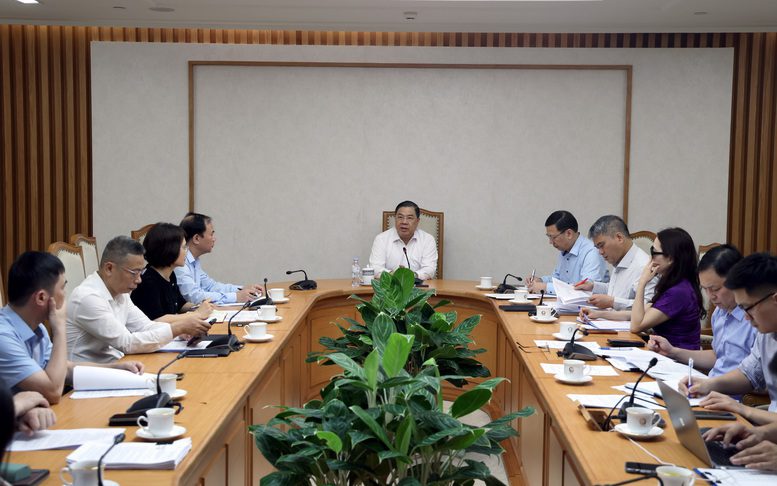
The Ministry of Construction focuses on resolving legal difficulties and obstacles for construction businesses.
Currently, the Ministry of Construction is continuing to develop 67 other legal normative documents, including 4 draft laws (Housing, Real Estate Business, Architecture, Vietnam Maritime and Inland Waterway), 8 decrees, and 55 circulars. The Ministry of Construction regularly reviews and monitors progress monthly; units that fall behind are immediately reviewed and addressed, as this is identified as a key task.
Opinions at the meeting emphasized the important role of the system of legal normative documents in the construction sector, which has a broad scope of management, significant social impact, and direct relevance to housing, real estate, construction, and many other fields. Therefore, the requirement is to ensure quality, synchronicity, and immediate enforceability upon promulgation.
Urgent Task of Institutional Completion and Improving Legislative Quality
At the meeting, opinions unanimously agreed on the direction to continue reviewing, improving, and streamlining the system of legal normative documents in the construction sector towards a clearer structure, ensuring uniformity and synchronicity between laws, decrees, and circulars, clearly defining which content falls under the scope of laws, which content is stipulated in government decrees, and which technical, mẫu, or detailed guidance content can be assigned to the Ministry for circular promulgation.
Concluding the meeting, Standing Deputy Prime Minister Phạm Gia Túc stated that the Ministry of Construction plays a crucial role in the country’s growth, as most activities of agencies, organizations, businesses, and citizens are related to the Ministry’s state management sector.
To date, the Ministry of Construction has submitted 20 out of 29 assigned documents (69%) to the Government and Prime Minister, including many important decrees and decisions. The work of cutting and simplifying administrative procedures and reducing compliance costs has seen positive changes. The Ministry of Construction is one of three ministries commended for reducing administrative procedures and compliance costs.
Besides the achieved results, the Ministry of Construction still faces delays in drafting and promulgating some decrees and legal normative documents, primarily due to subjective reasons ranging from drafting documents and soliciting opinions from ministries and agencies to appraisal work and incorporating explanations.
Removing Legal Bottlenecks, Creating Momentum for Sustainable Development
In the coming period, the Ministry of Construction’s legislative work needs to continue to embody the spirit of Resolution No. 66-NQ/TW of the Politburo on innovating the work of law-making and enforcement to meet the country’s development requirements in the new era. This means that laws should only stipulate framework issues and principled matters under the National Assembly’s authority, while constantly changing practical issues should be assigned to the Government, ministries, sectors, and localities for regulation to ensure flexibility and suitability with reality.
Regarding draft laws, the Standing Deputy Prime Minister requested the Ministry of Construction to accelerate progress and promptly complete the draft Vietnam Maritime and Inland Waterway Code project for submission to the Government, along with full drafts of guiding documents, draft decrees, and draft circulars, ensuring quality meets the National Assembly’s requirements.
Regarding the direction to amend and supplement the Housing Law and the Real Estate Business Law, the Ministry of Construction must urgently submit to the Party Central Committee Secretariat a draft Directive to replace Directive 34/CT-TW of the Secretariat on strengthening the Party’s leadership in the development of social housing in the new situation, serving as a basis for implementing the amendment of these two laws.
The Ministry of Construction needs to enhance coordination with the Ministry of Justice, the Government Office, and relevant agencies throughout the process of drafting, appraising, and submitting legal normative documents for promulgation; if necessary, the appraisal agency of the National Assembly may be invited to participate to accelerate the appraisal process and finalize documents.
For decrees detailing the implementation of the Construction Law and the Civil Aviation Law, the Standing Deputy Prime Minister requested ensuring decentralization, delegation of power, reduction of administrative procedures, combining the granting of autonomy and elimination of “sub-licenses” with strengthened inspection, control, and shifting from pre-audits to post-audits.
The Ministry of Construction must urgently receive feedback, provide explanations, and refine the draft decree already submitted to the Government, ensuring quality, progress, consistency of content with promulgated laws, synchronized effective dates, and avoiding legal gaps that hinder implementation.
Original article source: Construction Magazine