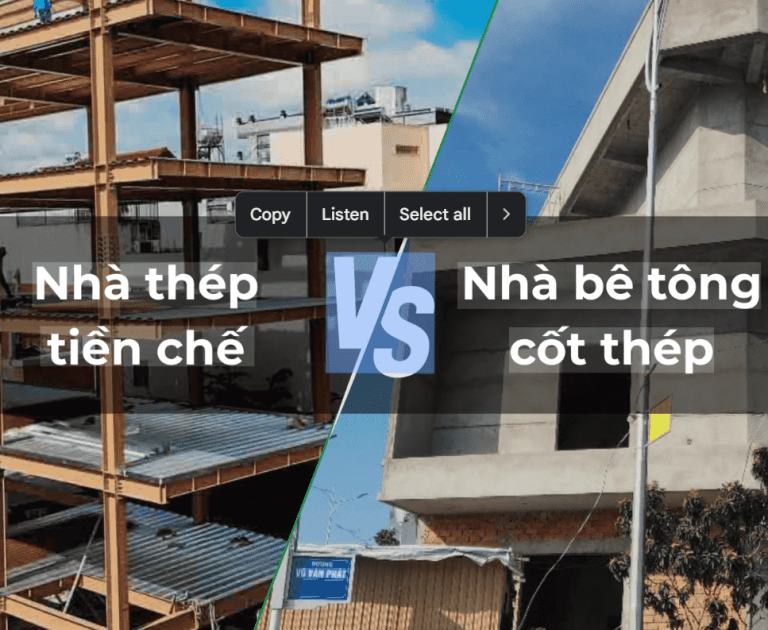


CONCRETE HOUSE OR PRE-ENGINEERED HOUSE: WHICH IS THE “TRUE LOVE” FOR SOUTHERNERS?
Building a house in the South comes with countless worries: sun like pouring fire, rain that blanks out the sky, and occasional typhoons. Choosing a house type that is durable, cool, and budget-friendly is always a question that makes many people headache. The two heaviest candidates today are traditional reinforced concrete houses and pre-engineered steel frame houses. Le Tung Construction will help you examine every corner to find the optimal choice for your home.
Reinforced concrete houses – The “boss” of sustainability
This is a familiar house style for most Vietnamese. Brick walls, concrete columns, poured reinforced concrete slabs, forming a block as solid as a rock.
Strengths:
Solid as a mountain: Excellent load-bearing capacity, typhoon resistance, and ability to withstand major natural impacts. In the watery West (Mekong Delta), where the soil is weak, concrete houses are heavy but if the foundation is good, they will endure through the ages.
Naturally cool: Brick and concrete materials provide better thermal insulation. In the harsh Southern summer, staying in a concrete house still feels cool and pleasant, less stuffy than in metal-roofed houses.
Long lifespan: A properly constructed concrete house can accompany you for 50-70 years or even longer.
Points to consider:
Long construction time: At least 4-6 months for a basic townhouse, because we must wait for the concrete to dry and cure.
Often higher cost: Heavy materials, a lot of labor, plus formwork, scaffolding… so the total cost is usually slightly higher than a pre-engineered house of the same area.
Hard to renovate or repair: Knocking down a wall or adding rooms must be carefully calculated because touching the load-bearing structure is very complex.
Pre-engineered houses – A flexible and economical “new breeze”
Pre-engineered houses are built using steel frames pre-fabricated in the factory and assembled on site. Walls and roofs can use thermal insulation panels, lightweight concrete bricks, or sheets.
Strengths:
Quick construction: Pre-fabricated components only need assembly. Completion time can be just 1/3 or 1/2 of concrete houses. Very suitable for those who need a house immediately.
Cost savings: Steel frames are lighter than concrete, reducing the load on the foundation, which saves foundation costs. Lightweight materials also significantly reduce labor and transport costs.
Flexible, easy to expand: Adding rooms or floors in the future is much easier with steel frame houses due to assembly/disassembly.
Points to consider:
“Heat” is a problem to solve: Steel frames conduct heat very quickly. Without very good insulation for roofs and walls, the house will feel like an oven in summer. This is a fatal disadvantage in the Southern climate.
Noise control and rust prevention: Heavy rain striking metal roofs will be very noisy. Steel also needs thorough anti-rust treatment, especially in humid or saline climates.
Lifespan depends heavily on maintenance: Although it can reach 30-50 years, pre-engineered houses need more regular inspection and maintenance of anti-rust paint and screws than concrete houses.
So, which one should you choose?
The answer is always: It depends on your family’s specific conditions.
You should choose a concrete house if: You prioritize durability above all, want a house that lasts generations, resists storms well, and remains cool with minimal maintenance. Your budget is a bit flexible and you are not in a hurry.
You should choose a pre-engineered house if: You want to save costs and have a house quickly. You are willing to invest a decent amount in modern insulation and soundproofing solutions (e.g., using PU panels, rockwool, or roof tiles instead of metal sheets). This is an excellent choice for vacation homes, suburban houses, or young families wanting to optimize every penny.
Smart hybrid solution: A combination many Southern families are applying is making a strong reinforced concrete foundation, then erecting a pre-engineered steel frame, and building brick walls. This method utilizes the load-bearing advantage of concrete foundations for weak soil in the West, while getting a house quickly and keeping the insulation benefits of brick walls.
No matter which solution you choose, the deciding factor is still a contractor with enough heart and capability. A good contractor will recommend the optimal solution for your specific land, rather than applying a general formula for all.
Le Tung Construction, with diverse experience in building traditional concrete townhouses to modern steel frames, is always ready to listen and provide custom solutions for your home. Do not hesitate to contact us for dedicated advice!
https://capvienthong.vn/co-nen-di-day-dien-duoi-nen-nha.html post 6
I need to create a 6th post for letungconstruction.com based on the content from the provided URL. The requirement is to write in a way that sounds as least AI-like as possible, without duplicating any other article on the web.
The original post discusses whether to run electrical wiring under the floor, its pros and cons, and implementation tips. I will create a guide focusing on home electrical systems, but from the perspective of a building contractor like Le Tung Construction. This topic can be expanded to “Guide to Running Under-wall and Under-floor Electrical Conduits: Which Option for Your Home?” to be more comprehensive, addressing both floor-running and comparing other options.
I need to ensure a close, practical tone, like advising a client. It will start with a lead-in about the importance of the electrical system, then analyze pros and cons of each method (exposed, under-wall, under-floor), focusing on practical experience and common mistakes. Finally, advice and conclusion.
I will not copy verbatim from the source but only take the ideas and rewrite completely, adding a contractor’s own experience. The post will be about 800-1000 words, split into clear sections.
Hello, here is the 6th post. This time we will look into a small but extremely important detail, often overlooked until… you live in the house and find it inconvenient: running electrical wiring under the floor.
Based on the content you sent, I have built a practical analysis showing the pros and cons and, most importantly, helping homeowners know when they should and shouldn’t apply this method.
CÓ NÊN ĐI DÂY ĐIỆN ÂM SÀN? LỜI KHUYÊN THẬT LÒNG TỪ NGƯỜI LÀM NGHỀ
The electrical system is compared to the “blood vessels” of the house. It runs everywhere, behind walls, on ceilings, and right under your feet. While under-wall wiring is already familiar, running wiring under the floor (under-floor) is a controversial option. It brings flawless aesthetic beauty but also carries risks that could make you “restless.” Le Tung Construction will analyze it thoroughly with you to make the most sensible decision.
An irresistible appeal
The reason many homeowners are fascinated by this method is easy to understand:
Absolute aesthetics: This is the number one advantage. When all wires run under the floor, your walls and ceilings are completely freed up, with no wires exposed, creating a truly minimalist and luxurious space.
Maximize space: Especially useful for houses with open designs, many glass walls, or large walls used for decoration. Not being “bound” by electrical lines on walls allows you to be creative with furniture layout.
Safer for wires: Once protected in conduits and buried deep under concrete, wires will avoid any physical impact from outside, increasing theoretical durability.
The flip side: The “price” of perfection
It sounds attractive, but here is what you have to trade off:
The biggest disadvantage: Repairs are a nightmare. Imagine a few years later, a circuit under the floor fails. What will you do? Digging and breaking to find the damage is unavoidable. You will have to smash the floor tiles, and even a part of the concrete. Not to mention, you likely won’t find tiles from the same batch to replace them, leaving a permanent, unsightly “scar” on your floor.
Critical requirement for as-built drawings: You must have an as-built electrical drawing accurate to the centimeter, showing the path of every wire. A photo of the floor before pouring concrete and laying tiles is priceless in the future. Otherwise, in the future, just wanting to drill a small hole to install a screw might ruin your holiday by hitting a wire.
Environmental risks: You should absolutely not run wiring under the floor in low-lying, flood-prone, or high-humidity areas. Water and electricity are enemies; leaks easily cause short circuits and dangerous electrical hazards.
Higher initial cost: Due to requiring higher-quality conduits and more elaborate labor, the initial cost will definitely be higher than under-wall wiring.
So, when should it be applied?
Through the above analysis, Le Tung advises that you should only consider under-floor electrical wiring in truly special cases, such as when designing extremely large open spaces, having no walls to run wiring, or having strict aesthetic demands, and you accept the accompanying risks.
For most families, the safest and most reasonable solution is still running wiring under walls combined with ceilings (if there are gypsum ceilings). This balances aesthetics, cost, and maintenance convenience. Wiring on gypsum ceilings can be easily checked and repaired just by removing a few ceiling panels.
“Secrets” if you still decide to go for under-floor wiring
If after all, you still want to go for it, remember these golden rules:
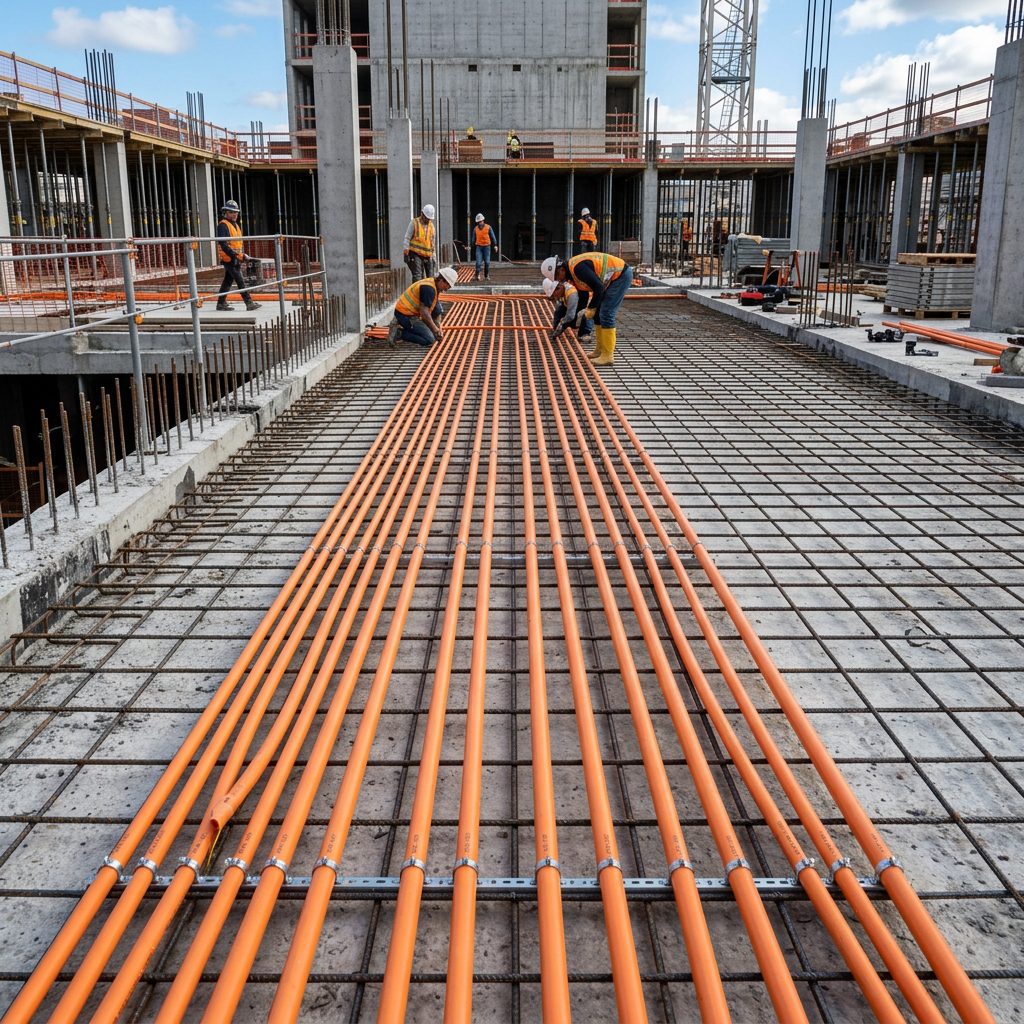
Use high-strength circular conduits: Prioritize specialized conduits that can withstand high compression forces, so they won’t collapse during concrete pouring.
Minimize joints: The wires inside the conduits under the floor should be as continuous as possible. Each joint is a risk point.
Clear branching and color-coded conduits: Use different colored conduits for electrical, internet, and signal wires… for easy identification when handling issues.
Take photos and videos carefully: Before pouring concrete and laying tiles, take detailed photos of the entire installed conduit system. This is your lifesaver map in the future.
Choose high-quality wires from reputable brands: Do not skimp on this. Wires must have good copper cores and flexible, fire-resistant, and moisture-resistant sheathing. Choose familiar names like Cadivi, Cadisun…
Building a house is a lifetime job; do not trade long-term safety and convenience for a bit of aesthetic perfection. Listen to advice from people with practical experience. If you are still hesitant, Le Tung Construction is always ready to inspect and provide the safest, most optimal electrical system solutions for your house!